


Best of Budapest & Hungary
Measure of Quality

Echoes of Korea in Hungarian Handmade Artworks
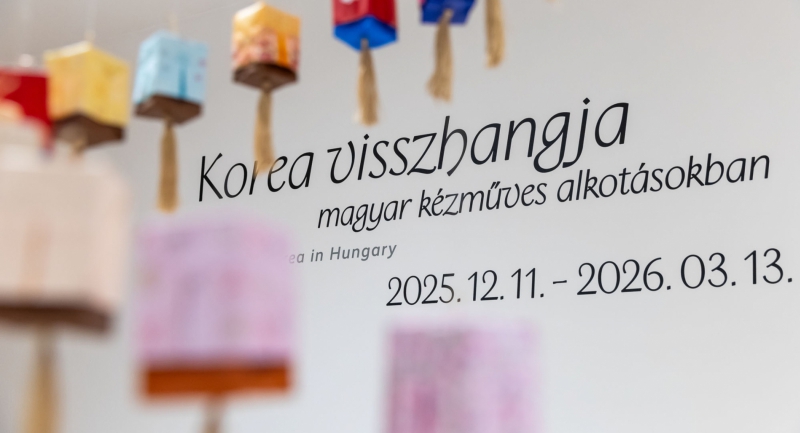
The Korean Cultural Center opens the year with a captivating exhibition titled “Echoes of Korea in Hungarian Handmade Artworks,” showcasing how the spirit of traditional Korean art resonates with the creativity of Hungarian artists. This presentation goes far beyond introducing a distant culture — it celebrates a living, evolving community where students become teachers and tradition is shaped through personal experience. The exhibition is open to the public through March 13 at the Korean Cultural Center in Budapest.
Since its founding in Hungary in 2012 with just three courses — gastronomy, calligraphy, and taekwondo — the Korean Cultural Center has seen remarkable growth in interest for Korean culture. Today, more than 1,600 programs annually attract nearly 15,000 participants, engaging audiences with everything from traditional crafts and performance arts to contemporary pop culture.
This exhibition is a unique imprint of that cultural dialogue. The works on display are not merely objects — they are stories, expressions of personal dedication, and creative energy born from the meeting of cultures.
Craft Workshop- Where Medup and Hanji Meet
The craft program introduces participants to the world of traditional Korean decorative knotting (medup) and Korean handmade paper artistry (hanji). Medup — a decorative knotting technique present in Korean culture for centuries — carries not just aesthetic value but deep symbolism: individual knots represent enduring bonds, timelessness, and good fortune. In contrast, hanji is a distinctive Korean paper made from natural fibers, prized for its exceptional durability and beauty, suitable not only for writing but also for creating various decorative and functional objects.
Under the guidance of Jakab Krisztina, participants not only delve into mastering these two techniques but also explore practical, everyday philosophies of Korean culture — a worldview where beauty, functionality, and spiritual content form a harmonious whole. The objects on display are some of the finest examples of this rich workshop practice.
Jogakbo- Stories Woven into Fabric
Korean patchwork, known as Jogakbo, emerged from the art of frugality and has grown into a powerful means of creative expression. The meticulously assembled geometric compositions made from leftover fabrics reflect the essence of Korean folk aesthetics. Led by Gold Mariann and Molnár Edit, the studio’s works featured in the exhibition embody deep cultural meanings, family narratives, and traditions woven into every stitch.
Minhva- Folk Painting Brought to Life
Minhva, the Korean folk painting tradition, vividly depicts everyday aspirations — such as luck, prosperity, and long life — through vibrant colors and rich symbolism. These works historically served a dual purpose: decorating homes and functioning as protective talismans. Representations often include mythical animals, flowers, or scenes from daily life, each carrying symbolic meaning or superstition — for example, tigers as protectors against evil spirits and fish symbolizing abundance and fortune. The “Szumdamcse” group — formed in 2023 — is guided by Kim Dasom and Szabó Dóra, and its members not only develop technical skills but also delve into the cultural and spiritual realms behind minhva. Their creations reflect both traditional respect and personal artistic insight.
Calligraphy- The Brush of the Soul
Korean calligraphy, known as soje, is much more than a writing system: it is a unique mode of inner harmony and self-expression. Each brushstroke reveals the artist’s personality and emotional nuance. The Korean Cultural Center’s calligraphy program began in 2013 under the direction of Master Moon Changseok, and today it is led by his former students — Bertalan Nóra, Bukta Zoltán, Csajka Edit, Fekete‑Preszmayer Zsófi, and Rónai Éva — across seven course levels. The works of more than 70 students are now on view in this exhibition.
An Active Cultural Encounter
More than a visual experience, Echoes of Korea is a tangible testament to how the spirit of Korean arts intersects with Hungarian creativity and imagination. The exhibition invites visitors not just to see, but to feel, interpret, and participate in a shared cultural journey.
The exhibition runs through March 13 at the Korean Cultural Center (Frankel Leó út 30–34, 1023 Budapest), welcoming all who are open to a deeper, shared cultural experience.